
Seattle’s tourism ecosystem is the integrated network of cultural venues, natural attractions, major events, cruise infrastructure, business conventions, accommodation, and transportation services that together support millions of visitors and billions in economic activity each year. In 2025, Seattle hosted 39.7 million visitors generating $8.8 billion in direct visitor spending and supporting over 68,000 jobs. That scale makes understanding how Seattle tourism works more than academic curiosity. For any traveler planning a visit, knowing how these interconnected sectors operate helps you make smarter choices, spend your time wisely, and experience the city the way locals actually live it.
What is Seattle’s tourism ecosystem and how does it work?
Seattle’s tourism ecosystem is best understood using the industry term destination ecosystem, which describes how attractions, services, and infrastructure function as interdependent parts of a single economic and experiential system. No single venue or sector drives Seattle tourism alone. Instead, Pike Place Market, Seattle Center, the cruise terminals at Smith Cove and Bell Street, the Seattle Convention Center, and the city’s 200 miles of shoreline all reinforce each other, drawing visitors in and passing them through a web of hospitality, retail, food, and entertainment businesses.
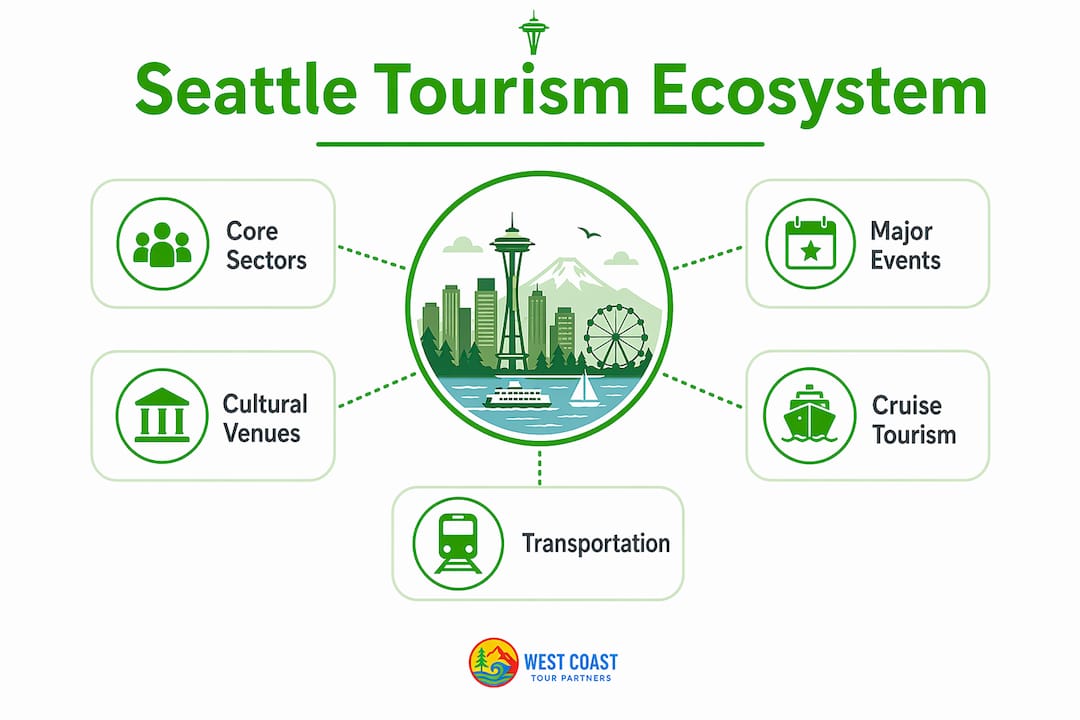
The ecosystem divides into five core sectors: cultural and arts venues, major events and conventions, cruise tourism, outdoor and natural attractions, and transportation networks. Each sector feeds the others. A cruise passenger arriving at Pier 91 needs a hotel, a meal, a tour, and a way to get around. That single visitor touches at least four sectors before boarding the ship. Multiply that by nearly 2 million cruise passengers expected in 2025, and you begin to see why the system is described as an ecosystem rather than a collection of separate businesses.
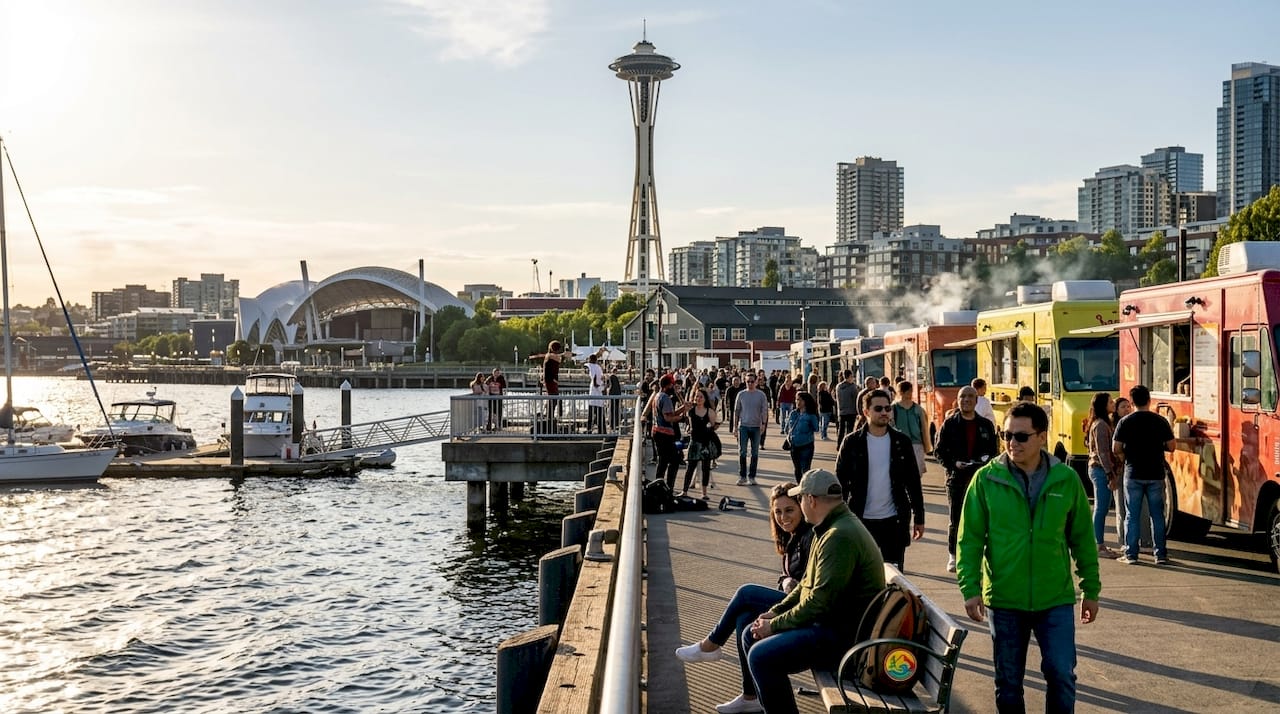
The economic output is equally distributed. Seattle tourism generates $840 million in state and local taxes annually, providing a $893 tax offset per King County household. That means every resident benefits financially from the visitors walking through Pike Place Market or attending a show at Seattle Center. Tourism here is not a niche industry. It is a civic infrastructure.
What are the major attractions and cultural hubs fueling Seattle’s tourism?
Seattle Center and Pike Place Market function as the twin anchors of the city’s attraction ecosystem, drawing visitors who then radiate outward into neighborhoods, restaurants, and smaller experiences.
Seattle Center alone attracts nearly 12 million visitors annually, generating $3.3 billion in economic activity and supporting 19,400 jobs. It produces more than $37 million in local tax revenue per year. Those numbers reflect a 74-acre campus that houses the Space Needle, Chihuly Garden and Glass, the Museum of Pop Culture (MoPOP), KeyArena (now Climate Pledge Arena), and the Pacific Science Center, all operating within walking distance of each other. The concentration of world-class venues in one location is not accidental. Seattle Center is deliberately designed as a civic ecosystem where arts, sports, parks, and events operate interdependently to sustain long-term tourism growth.
Pike Place Market adds a different dimension. Founded in 1907, it is one of the oldest continuously operating farmers markets in the United States, and it draws an estimated 10 million visitors per year. What makes Pike Place remarkable within the ecosystem is its layered function:
- A working market with over 500 vendors selling fresh produce, seafood, and crafts
- A food and beverage destination with dozens of restaurants and the original Starbucks at 1912 Pike Place
- A historic district with underground tours, hidden corridors, and stories that reward curious visitors
- A social media magnet where the fish-throwing tradition at Pike Place Fish Market generates organic content and word-of-mouth marketing globally
West Coast Tour Partners has built The Market Experience specifically around Pike Place’s layered identity, combining guided storytelling, scavenger hunts, local food tastings, and interactive puzzles to help guests move beyond the surface and discover what most visitors miss entirely.
How do major events and conventions shape Seattle’s tourism landscape?
Large-scale events and year-round convention business are the two forces that prevent Seattle’s tourism economy from collapsing into pure summer seasonality.
The most significant near-term catalyst is the FIFA World Cup 2026. Seattle is projected to host 750,000 visitors for its World Cup matches, generating at least $929 million for King County and over $100 million in direct tax revenue while supporting 20,762 jobs. For context, that single event represents roughly 10% of Seattle’s entire annual visitor spending compressed into a few weeks. The ripple effect will touch every sector of the ecosystem simultaneously: hotels, restaurants, transportation, retail, and attractions.
The convention sector plays a quieter but equally vital role throughout the rest of the year. The Seattle Convention Center expansion drives year-round convention business and directly offsets the seasonal variability that plagues many tourism-dependent cities. Convention attendees sustain hotels and restaurants especially during slower leisure travel periods in fall and winter, when leisure visitors drop off sharply. Business travelers and convention delegates spend more per day than leisure tourists and book further in advance, giving the hospitality sector the revenue predictability it needs to maintain staffing and service quality year-round.
Here is how the event and convention sector integrates into the broader ecosystem:
- Convention delegates arrive year-round, filling hotel rooms and restaurants during off-peak leisure months
- Major sporting events at Climate Pledge Arena and Lumen Field generate concentrated visitor surges that benefit the entire waterfront and downtown corridor
- Cultural festivals like Bumbershoot and Seattle International Film Festival attract domestic and international visitors who extend their stays to explore the city
- FIFA World Cup 2026 will introduce Seattle to a global audience, with long-term marketing benefits extending well beyond the tournament itself
Pro Tip: If you are visiting Seattle during the FIFA World Cup 2026, book accommodation at least six months in advance. Hotel rates in King County are expected to surge significantly during match weeks, and properties near Seattle Center and the waterfront will sell out first.
What role does cruise tourism and transportation play in Seattle’s tourism ecosystem?
Seattle is North America’s primary departure point for Alaska cruises, and that position shapes the entire visitor economy from May through September.
Nearly 2 million cruise passengers are expected to pass through Seattle in 2025, and each one represents a bundle of economic activity beyond the cruise fare itself. Pre-cruise visitors typically arrive one to three days early, filling downtown hotels and spending on meals, tours, and retail. Post-cruise passengers often extend their stays to explore the city before flying home. The result is a concentrated injection of visitor spending that benefits businesses far beyond the waterfront terminals.
The transportation network connecting these visitors to the broader city is a critical and often underappreciated part of how Seattle tourism works:
| Transportation Layer | Function | Key Connection Points |
|---|---|---|
| Cruise terminals (Pier 91, Pier 66) | Primary arrival point for Alaska cruise passengers | Downtown Seattle, hotels, Pike Place Market |
| Seattle-Tacoma International Airport | Gateway for domestic and international arrivals | Light rail to downtown in 38 minutes |
| King County Metro and Sound Transit | Urban mobility for visitors without rental cars | Seattle Center, Capitol Hill, Pioneer Square |
| Waterfront streetcar and ferry | Scenic connections along Elliott Bay | Bainbridge Island, West Seattle, waterfront attractions |
The pressure point in this system is accommodation capacity during peak cruise season. Summer months see significantly higher crowds and accommodation costs, and visitors who arrive without reservations often find limited options near the waterfront. West Coast Tour Partners addresses this gap directly through the Let’s Go Seattle! Shuttle, which connects cruise terminals to hotels, Pike Place Market, and city attractions while turning the ride itself into an entertaining, story-driven orientation to the city.
How does Seattle’s natural and urban environment integrate into the tourism ecosystem?
Seattle carries a “hybrid identity” as an “adventure culturist” destination, a city where urban sophistication and abundant natural outdoor experiences exist within the same geography. That identity is not marketing language. It is a structural feature of the ecosystem.
“Seattle’s appeal hinges on blending urban culture with abundant high-quality natural attractions, creating an ‘adventure culturist’ visitor experience that few North American cities can match.” — Visit Seattle’s Stephanie Byington
The city offers 200 miles of shoreline and over 6,000 acres of parks, and most of it is accessible without a car. Discovery Park, the largest green space in Seattle at 534 acres, sits minutes from downtown. Mount Rainier National Park is a 90-minute drive. The Olympic Peninsula and its old-growth rainforests are reachable by ferry and car in under two hours. This proximity to world-class nature is a major driver of visitor satisfaction and repeat visitation.
The outdoor dimension of Seattle tourism also shapes seasonal patterns in ways that matter for planning:
- Summer (June through August) brings peak crowds, maximum accommodation prices, and the best weather for outdoor activities including kayaking on Lake Union, hiking in the Cascades, and whale watching in the San Juan Islands
- Spring and fall offer shoulder-season value with fewer crowds, lower hotel rates, and still-pleasant conditions for urban exploration and light outdoor activity
- Winter draws visitors for holiday markets, indoor cultural experiences at Seattle Center, and proximity to ski resorts like Crystal Mountain and Stevens Pass
The natural environment also feeds the food culture that defines Seattle’s culinary tourism. Dungeness crab, Pacific salmon, Walla Walla sweet onions, and Washington State wines all appear on menus throughout the city, creating a direct sensory connection between the natural landscape and the urban dining experience.
Key takeaways
Seattle’s tourism ecosystem functions as an integrated civic infrastructure where cultural venues, natural attractions, cruise arrivals, major events, and year-round convention business reinforce each other to generate billions in economic activity and tens of thousands of jobs.
| Point | Details |
|---|---|
| Ecosystem scale | Seattle hosted 39.7 million visitors in 2025, generating $8.8 billion in direct spending and 68,000+ jobs. |
| Anchor attractions | Seattle Center and Pike Place Market together generate billions in economic activity and serve as the ecosystem’s cultural core. |
| Event-driven growth | FIFA World Cup 2026 alone is projected to bring 750,000 visitors and $929 million to King County. |
| Cruise and transport | Nearly 2 million cruise passengers flow through Seattle annually, touching hotels, tours, dining, and retail across the city. |
| Natural-urban balance | Seattle’s 200 miles of shoreline and 6,000+ acres of parks create a rare “adventure culturist” identity that extends visitor appeal across all seasons. |
Why the ecosystem model matters more than most visitors realize
From where West Coast Tour Partners sits, the single biggest mistake visitors make is treating Seattle’s attractions as a checklist rather than a connected experience. You visit the Space Needle, check. You walk through Pike Place, check. You take a photo of the original Starbucks, check. And then you leave feeling like you saw Seattle without ever actually feeling it.
The ecosystem model matters because it reveals that the real value of a Seattle visit comes from the connections between experiences, not the experiences themselves in isolation. A cruise passenger who takes the Let’s Go Seattle! Shuttle from Pier 91, stops at Pike Place for The Market Experience, rides a scooter through the waterfront with ScooTours, and ends the day watching the sunset from Kerry Park has not just visited four attractions. They have moved through the city the way the ecosystem was designed to be experienced.
The convention business insight is the one that surprises most leisure travelers: the backbone of Seattle tourism is not the Space Needle or even the cruise industry. It is the year-round convention and corporate travel sector that keeps hotels staffed, restaurants open, and the hospitality workforce employed through the gray months of November through March. That stability is what allows the leisure tourism infrastructure to be world-class when you arrive in July. The two sectors are inseparable, even if you never attend a single conference.
The challenge going forward is managing the tension between growth and livability. The FIFA World Cup 2026 will test Seattle’s infrastructure in ways that no previous event has. How the city handles that pressure will define its reputation as a destination for the next decade.
— WCTP_Systems
Experience Seattle’s ecosystem with West Coast Tour Partners
Seattle’s tourism ecosystem rewards visitors who move through it with intention, not just a map and a list of landmarks.
West Coast Tour Partners designs experiences that connect the city’s major touchpoints into one memorable visit. From The Market Experience at Pike Place, which uncovers the market’s hidden history through storytelling and food tastings, to the Let’s Go Seattle! Shuttle that turns your ride from the cruise terminal into a city orientation you will actually remember, every product is built to help you experience the ecosystem rather than just observe it. The Friends Pass bundles attractions, transportation, and experiences into one platform so you spend less time planning and more time discovering. Start your Seattle adventure at West Coast Tour Partners and find the experience that fits your visit.
FAQ
How many visitors does Seattle attract each year?
Seattle hosted 39.7 million visitors in 2025, generating $8.8 billion in direct visitor spending and supporting over 68,000 jobs across the tourism and hospitality sectors.
What are the main components of Seattle’s tourism ecosystem?
Seattle’s tourism ecosystem includes cultural venues like Seattle Center and Pike Place Market, cruise tourism through Smith Cove and Bell Street terminals, the Seattle Convention Center, outdoor natural attractions, and an integrated transportation network connecting all sectors.
When is the best time to visit Seattle?
Summer offers the best weather and the most events, but also the highest prices and largest crowds. Shoulder seasons in spring and fall provide a strong visitor experience with lower accommodation costs and shorter lines at major attractions.
What impact will FIFA World Cup 2026 have on Seattle tourism?
FIFA World Cup 2026 is projected to bring 750,000 visitors to Seattle, generating at least $929 million for King County and over $100 million in direct tax revenue while supporting more than 20,000 jobs.
How does cruise tourism fit into Seattle’s broader travel industry?
Seattle is North America’s primary Alaska cruise departure port, with nearly 2 million passengers expected annually. Cruise visitors generate significant pre and post-cruise spending on hotels, dining, tours, and transportation throughout the city.
Recommended
- What to Know Before Visiting Seattle: 2026 Guide – West Coast Tour Partners
- Top 4 savorseattle.com Alternatives Providers 2026 – West Coast Tour Partners
- Top 3 eatseattletours.com Alternatives Providers 2026 – West Coast Tour Partners
- What Is Pike Place Market? Seattle’s Historic Public Market – West Coast Tour Partners
Leave a Reply