
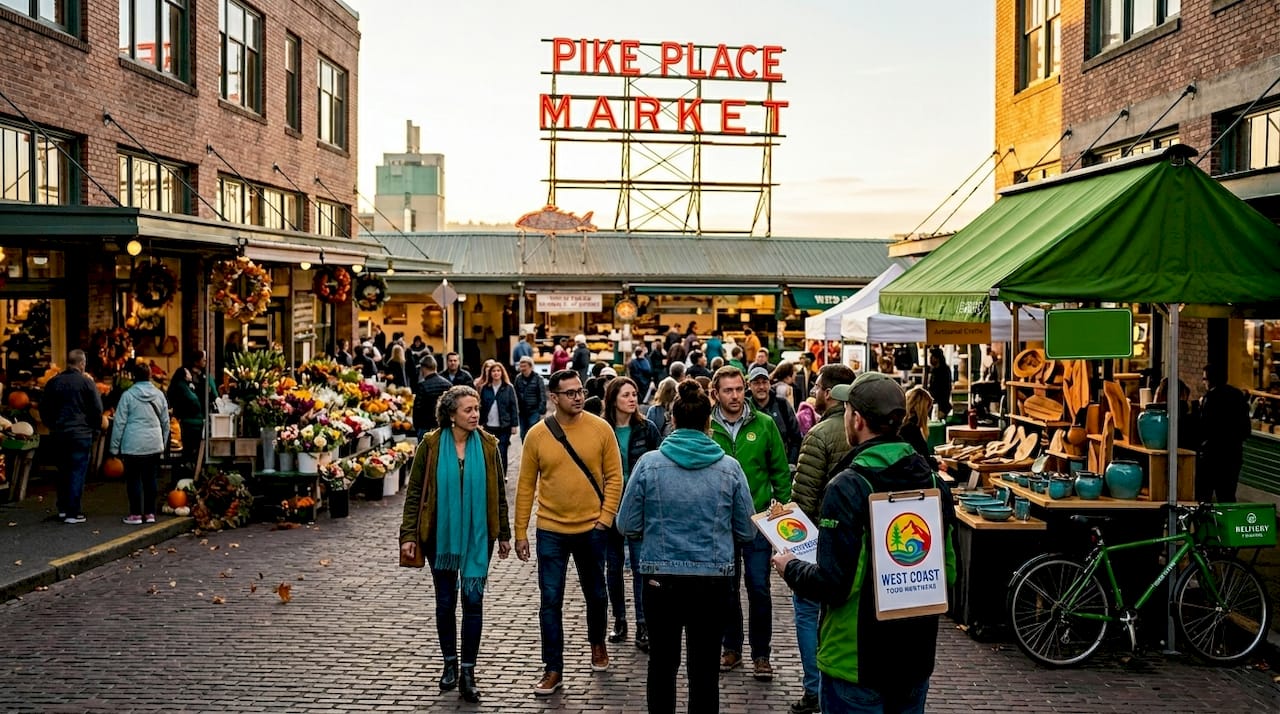
The Seattle Market District tour is a guided or self-guided exploration of Pike Place Market, America’s oldest continuously operated public farmers market, combining fish-throwing traditions, historic architecture, local food, and living commerce into one unforgettable experience. Most visitors treat it as a quick photo stop. That’s a mistake. The Market District rewards those who slow down, look up, and wander off the main corridor. This guide gives you everything you need to experience it the right way, including 2026 updates on access, timing, and what makes a guided tour worth every dollar.
What the Seattle Market District tour actually covers
The Market District centers on Pike Place Market, which opened August 17, 1907, and has operated continuously ever since. That longevity is not just a trivia fact. It means the market functions as a real, working commercial hub where local farmers, fishmongers, artisans, and restaurateurs earn their living every single day. You are not walking through a replica or a themed attraction. You are walking through a place that has fed Seattle for over a century.
The core attractions visitors encounter on any Market District tour include:
- Pike Place Fish Market: The fishmongers here turned a practical task into performance art. Fish-throwing began as a practical method for moving product quickly across the stall, but it evolved into a theatrical crowd-pleaser that now defines the market’s personality worldwide.
- The Gum Wall: Located in Post Alley just below the main market entrance, this brick wall covered in thousands of pieces of chewed gum has become one of Seattle’s most photographed spots. It started in the early 1990s when theater patrons stuck gum to the wall while waiting in line.
- Rachel the Pig: The bronze piggy bank near the main entrance serves as the market’s mascot and a beloved photo subject. Rachel collects donations that fund social services for low-income residents in the market neighborhood.
- Main Arcade: The long open corridor lined with flower vendors, produce stalls, and craft sellers is the sensory heart of the market. Colors, smells, and sounds overlap in a way that no photograph fully captures.
- Victor Steinbrueck Park: Positioned at the north end of the market, this small park offers sweeping views of Elliott Bay and the Olympic Mountains. It is one of the best free viewpoints in all of Seattle.
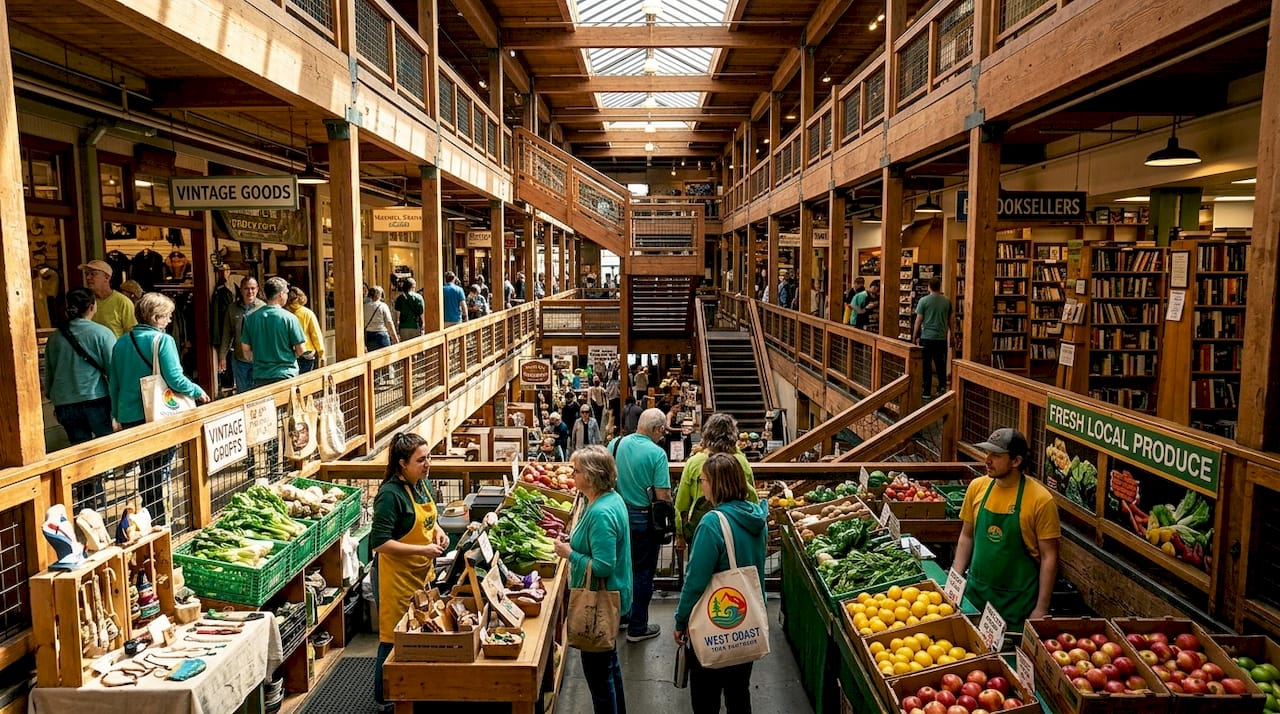
The market also has a complex, multi-level layout with ramps, stairs, and connecting corridors that link the main building to the Sanitary Public Market, lower-level shops, and Post Alley. Many visitors spend an hour on the main floor and leave thinking they have seen everything. They have not.
Pro Tip: Walk down at least one level below the main arcade. The lower floors hold independent booksellers, vintage shops, and specialty food vendors that most tourists walk right past.
How to plan your visit: timing, duration, and access
A well-planned Market District visit follows a clear sequence. Here is how to structure your time for the best experience:
- Arrive early if you want calm. The market opens at 9 a.m. for most vendors. Arriving before 10 a.m. gives you open corridors, cooperative vendors happy to chat, and far better photo conditions without crowds blocking every frame.
- Budget 2 to 4 hours. Visitors typically spend 2 to 4 hours exploring the market fully. Ticketed tours start promptly and do not wait for latecomers, so plan to arrive at least 10 minutes before your tour begins.
- Check the 2026 street management plan. The Pike Place Market Preservation and Development Authority (PDA) has implemented vehicle restrictions from 10 a.m. to 4 p.m. on weekdays, with expanded pedestrian zones running through Labor Day 2026. Deliveries, ADA vehicles, and emergency services are exempt, but general vehicle access is limited. Plan your drop-off or rideshare pickup accordingly.
- Factor in the Sip and Savor program. The PDA’s Sip and Savor open container program allows visitors to carry alcoholic beverages purchased from market vendors in designated areas during summer 2026. This changes the pacing and social atmosphere noticeably, especially on weekend afternoons.
- Wear comfortable shoes. The market involves significant walking on uneven surfaces, cobblestones, and sloped ramps. Mobility considerations matter here. If you or someone in your group has limited mobility, call ahead to confirm accessible route options before booking a walking tour.
Pro Tip: Midday on a Saturday is the most atmospheric time to visit, but also the most crowded. If you want the full sensory experience without feeling overwhelmed, aim for a Tuesday or Wednesday morning.
Why the market’s history shapes every tour experience
Pike Place Market opened with a specific purpose: to cut out the middlemen and connect Seattle residents directly with local farmers and producers. That founding mission still defines the market’s identity today. The PDA, formally known as the Pike Place Market Preservation and Development Authority, governs the market not just as a historic building but as a living community institution. Its mandate covers affordable housing, social services, and commercial space for small vendors, all within the same historic footprint.
This preservation model is what separates Pike Place Market from other famous public markets. The architecture matters, but the ongoing working operations matter more. When you watch a farmer arrange heirloom tomatoes at 8 a.m. or a fishmonger call out to passing tourists, you are witnessing the same commercial culture that has existed here since 1907.
Here is how the market’s history shows up in the tour experience:
- Fish-throwing tradition: Guides explain that the theatrical toss began as a functional technique and became a performance that now draws crowds at scheduled intervals throughout the day.
- The pig mascot: Rachel the Pig was created by local artist Georgia Gerber in 1986. The story behind her placement and purpose connects the market’s commercial life to its social mission.
- The Gum Wall: What started as a nuisance became a cultural artifact. The wall was cleaned in 2015 and immediately began filling up again, which says something genuine about how visitors connect with the market.
- The Sanitary Public Market building: Built in 1910 and named to emphasize that no horses were allowed inside (a major selling point at the time), this building now houses some of the market’s best independent eateries.
| Aspect | Then | Now |
|---|---|---|
| Original purpose | Direct farmer-to-consumer sales | Still operating with same model |
| Governance | City-managed market stalls | PDA oversees preservation and operations |
| Architecture | Single main building | Multi-building Historic District |
| Cultural role | Food supply for Seattle residents | Tourism, community, and commerce combined |
The market’s identity rests on this continuity. A tour that skips the history leaves you with a collection of photos instead of a genuine understanding of why this place matters.
What makes a guided tour different from walking it yourself?
The honest answer is: context. Self-guided visitors who know the two-sided market layout can navigate effectively, but most newcomers get funneled into the tourist-heavy main corridor and miss the Sanitary Public Market building entirely. A licensed guide changes that immediately.
Guided tours inside the Pike Place Market Historic District require PDA approval and licensing. That licensing requirement is not bureaucratic red tape. It protects vendors from disruption and ensures guides meet a standard of knowledge and conduct. Tours like Savor Seattle operate under this framework, offering storytelling-driven experiences that connect visitors to specific vendors, explain the market’s governance, and reveal corners that most people walk past without a second glance.
The benefits of choosing a guided experience include:
- Storytelling depth: A skilled guide explains why the fish-throwing tradition matters culturally, not just what it looks like. Guided tours that focus on hidden history and local nuance consistently deliver richer, more memorable experiences than landmark-pointing alternatives.
- Vendor connections: Licensed guides often have relationships with specific vendors and can introduce you to people and products you would never discover on your own.
- Pacing and structure: Food tours at the market are timed walking experiences requiring active participation. A good guide manages the pace so you cover the full market without rushing or standing around waiting.
- Avoiding the tourist trap zones: Guides know which stalls are worth your time and which are primarily designed to capture foot traffic from people who do not know better.
- The “adult field trip” experience: The best guided market tours feel less like a checklist and more like spending focused time with a local who genuinely loves this place. That distinction is the difference between a good afternoon and a great one.
West Coast Tour Partners designs its Market Experience tours around exactly this philosophy, blending storytelling, food tastings, scavenger hunts, and interactive challenges into an experience that feels personal rather than scripted.
Key takeaways
The Seattle Market District tour delivers the most value when visitors treat Pike Place Market as a living cultural institution rather than a photo backdrop, and when they choose a licensed guided experience over a self-directed walk.
| Point | Details |
|---|---|
| Market history matters | Pike Place Market has operated continuously since 1907, and its preservation model shapes every aspect of the visitor experience. |
| Plan for 2 to 4 hours | A thorough visit covering both market buildings, lower levels, and key landmarks takes at least two hours minimum. |
| Arrive early or midweek | Early mornings and weekday visits offer calmer conditions, better vendor interactions, and easier navigation. |
| Choose a licensed guide | PDA-approved tours reveal hidden history, vendor stories, and layout details that self-guided visitors routinely miss. |
| Check 2026 access rules | Vehicle restrictions and the Sip and Savor program affect how you arrive, move through, and pace your visit this season. |
My honest read on the Market District experience
I have watched a lot of visitors spend 45 minutes at Pike Place Market, snap a photo of the fish toss, buy a bouquet of dahlias, and leave thinking they got the full experience. They did not. The market’s real value lives in the spaces between the famous stops.
The multi-level layout is not a design flaw. It is an invitation. Every ramp and staircase leads somewhere worth seeing, whether that is a tiny bookshop on the lower level, a craftsperson working in a back corner, or a window seat at a café with an unobstructed view of Elliott Bay. The visitors who discover those spots are the ones who leave talking about the market for years.
The 2026 pedestrian management changes are genuinely good for the experience. Fewer vehicles on Pike Place Street during peak hours means you can actually stand still, look around, and absorb the atmosphere without dodging traffic. The Sip and Savor program adds a social layer that makes afternoon visits feel more relaxed and communal. Both changes reward visitors who plan ahead.
My strongest advice: resist the urge to check off landmarks and move on. The market is not a list. It is a neighborhood with a pulse, and the best way to feel that pulse is to slow down, talk to the vendors, and let yourself get a little lost between floors.
— WCTP_Systems
Explore the Market District with West Coast Tour Partners

West Coast Tour Partners offers immersive, story-driven Market District experiences designed for visitors who want more than a standard walkthrough. The Market Experience combines guided storytelling, local food and drink tastings, scavenger hunts, and hidden-history reveals into a single visit that covers both sides of the market, the lower levels, and the cultural traditions that make Pike Place Market genuinely unique. Guides are knowledgeable, licensed, and passionate about Seattle’s history. Booking is straightforward, and experiences are designed to work for a wide range of mobility levels and group sizes. If you are ready to experience the Market District the way locals know it, book your Seattle tour with West Coast Tour Partners today.
FAQ
How long does a Seattle Market District tour take?
Most visitors spend 2 to 4 hours exploring Pike Place Market thoroughly. Ticketed guided tours typically run 1.5 to 2 hours, with self-guided visits often extending longer depending on how much time you spend at individual stalls.
Is entry to Pike Place Market free?
Entry to the market itself is free. Food, shopping, guided tours, and individual vendor experiences all carry separate costs, with prices varying by vendor and tour operator.
What is the best time to visit Pike Place Market?
Early morning on a weekday offers the calmest conditions and the best vendor interactions. Midday on weekends delivers the most atmosphere but also the largest crowds. The 2026 pedestrian management plan makes daytime weekday visits particularly pleasant.
Do I need a licensed guide for a Pike Place Market tour?
You do not need a guide to walk through the market, but guided tours inside the Historic District must be PDA-approved and licensed. Licensed tours like those offered by West Coast Tour Partners provide storytelling, vendor connections, and layout knowledge that significantly enrich the experience.
What should I wear to the Market District?
Wear comfortable, flat-soled shoes. The market involves walking on cobblestones, sloped ramps, and uneven surfaces across multiple levels. Layers are recommended, as Seattle weather can shift quickly even in summer.
Leave a Reply