
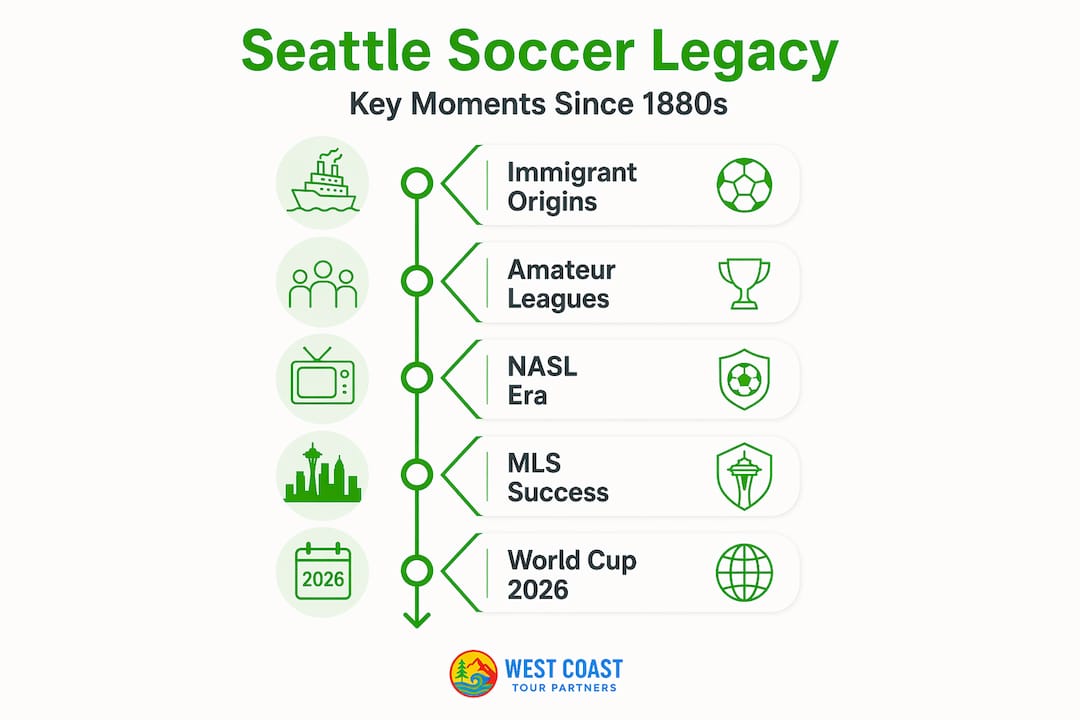
Seattle’s soccer story surprises nearly every fan who hears it. Most people assume the sport took root here when Major League Soccer arrived in 2009. The real seattle history for soccer fans explained reaches back to the 1880s, when immigrant coal miners arrived in the Pacific Northwest with soccer already in their blood. What grew from those early pickup games became one of the most passionate, community-driven soccer cultures in North America. This article walks you through every chapter, from the first documented match near Chehalis to the 2026 FIFA World Cup putting Seattle on the global stage.
Table of Contents
- Key takeaways
- Seattle history for soccer fans: the immigrant origins
- The original Seattle Sounders and the NASL era
- Seattle Sounders FC and the modern era of success
- Youth soccer, women’s soccer, and statewide growth
- The 2026 FIFA World Cup and Seattle’s global moment
- My take on what this history means for fans today
- Experience Seattle’s soccer legacy in person
- FAQ
Key takeaways
| Point | Details |
|---|---|
| Deep immigrant roots | Seattle soccer history begins in the 1880s, driven by Welsh, Italian, and German immigrant communities. |
| NASL era shaped fan culture | The original Seattle Sounders debuted in 1974 and immediately sold out Memorial Stadium, setting the tone for fan loyalty. |
| Modern Sounders lead MLS | Seattle Sounders FC has won nine major trophies, making the club the most decorated in American soccer history. |
| Youth and women’s soccer matter | The Seattle Youth Soccer Association and Seattle Reign FC built the grassroots foundation that supports the pro game today. |
| 2026 World Cup amplifies legacy | Seattle hosting six World Cup matches connects its historic soccer identity to a global audience for the first time. |
Seattle history for soccer fans: the immigrant origins
Long before professional contracts and Lumen Field, soccer in Seattle belonged to working people. Welsh and Italian coal miners brought the game to the Pacific Northwest as early as the 1880s, kicking balls around mining camps and waterfront yards after long shifts underground. The first documented game in Washington state was recorded in 1890, just one year after statehood, played near Chehalis among these immigrant communities.
What made this foundation so durable was the way the game spread. Sailors arriving at Puget Sound docks carried soccer from port to port, introducing new styles and energy. German, Scandinavian, and Italian immigrants formed ethnic community leagues that gave people a social anchor in a new country. Soccer was not just recreation. It was identity, culture, and belonging packed into 90 minutes.
Here is what shaped those early decades of Seattle soccer history:
- Welsh and Italian coal miners organized the earliest informal matches in mining camp clearings across Western Washington
- Ethnic leagues formed by immigrant communities created a structured, competitive scene long before any governing body existed
- Railroad expansion in the 1890s connected remote camps to Seattle, spreading soccer talent and interest toward the city
- Sailors arriving at Puget Sound docks brought international soccer knowledge and informal competition to the waterfront neighborhoods
- Scandinavian and German immigrant clubs added distinct tactical styles, making Seattle’s early soccer culture genuinely multicultural
By the 1920s and 1930s, these community roots had grown into organized amateur leagues across the city. The sport was never a novelty here. It was built into the social fabric of entire neighborhoods.
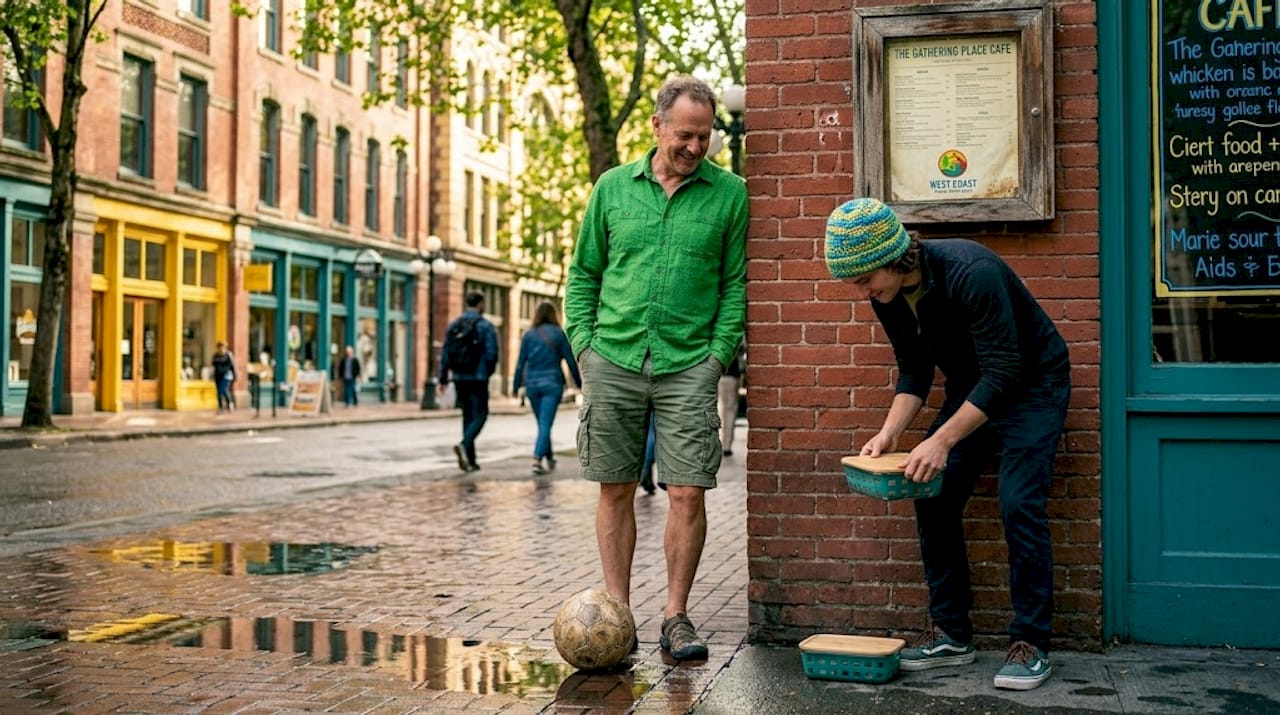
Pro Tip: If you want to feel the weight of this history firsthand, walk through Pioneer Square and the Pike Place Market district. These neighborhoods were the literal meeting grounds of the immigrant communities who first organized soccer in Seattle.
The original Seattle Sounders and the NASL era
The 1970s gave Seattle’s soccer culture its professional identity, and the story of that leap is extraordinary. The original Seattle Sounders debuted in the North American Soccer League (NASL) in 1974, and what happened at Memorial Stadium immediately signaled something different about this city.
- The Sounders became the first NASL team to sell out their home venue, drawing over 13,500 fans from the very first games.
- Demand was so immediate that the stadium expanded capacity by 1,500 seats to meet it, a move almost unheard of for a new franchise in its debut season.
- Players did not live behind a velvet rope. Players attended picnics and stayed in fans’ homes, building a communal bond that shaped Seattle soccer fan culture for generations.
- Youth soccer exploded in parallel. The Seattle Youth Soccer Association grew from just 24 teams in 1962 to over 1,000 teams by 1974, a pace of growth that no other city matched.
- When the NASL collapsed in 1984, the fan base did not dissolve. It regrouped through amateur leagues, smaller professional circuits, and an unshakeable belief that top-level soccer would return.
That last point deserves emphasis. The collapse of the NASL broke the hearts of soccer fans in most American cities. In Seattle, it sharpened the loyalty. Fans who had watched their team disappear overnight became the people who fought hardest to bring professional soccer back.
“In Seattle, soccer wasn’t waiting for America to catch up. Seattle was already there.”
The NASL era also planted something unusual in the culture. The relationship between players and fans was genuinely personal. Families hosted players for Sunday dinners. Kids grew up knowing their favorite Sounders midfielder by first name. This closeness, this family atmosphere dating back to those early NASL years, became the defining emotional texture of Seattle soccer fan culture.
Seattle Sounders FC and the modern era of success
When Seattle Sounders FC joined MLS in 2009, the expectation was strong support. What actually happened surpassed every projection. Over 30,000 fans showed up for the home opener, and the club quickly set records for attendance across the entire league.
The on-field success followed. As of May 2026, Seattle Sounders FC has won nine major trophies, making them the first club in U.S. soccer history to win every major competition available, including the MLS Cup, the Supporters’ Shield, the U.S. Open Cup, the Leagues Cup, and the Concacaf Champions Cup.
| Trophy | Significance |
|---|---|
| MLS Cup | Top prize in American club soccer |
| Supporters’ Shield | Best regular season record in MLS |
| U.S. Open Cup | Oldest soccer competition in the U.S. |
| Concacaf Champions Cup | Premier club championship in North and Central America |
| Leagues Cup | Competition between MLS and Liga MX clubs |
The fan culture around this modern era has its own distinct rituals. The March to the Match is the most visible. Thousands of supporters gather before home games, drums beating, scarves raised, marching as a unified group toward Lumen Field. The March to the Match has helped create one of the loudest and most intimidating home atmospheres in North American soccer, and visiting teams genuinely feel the difference.
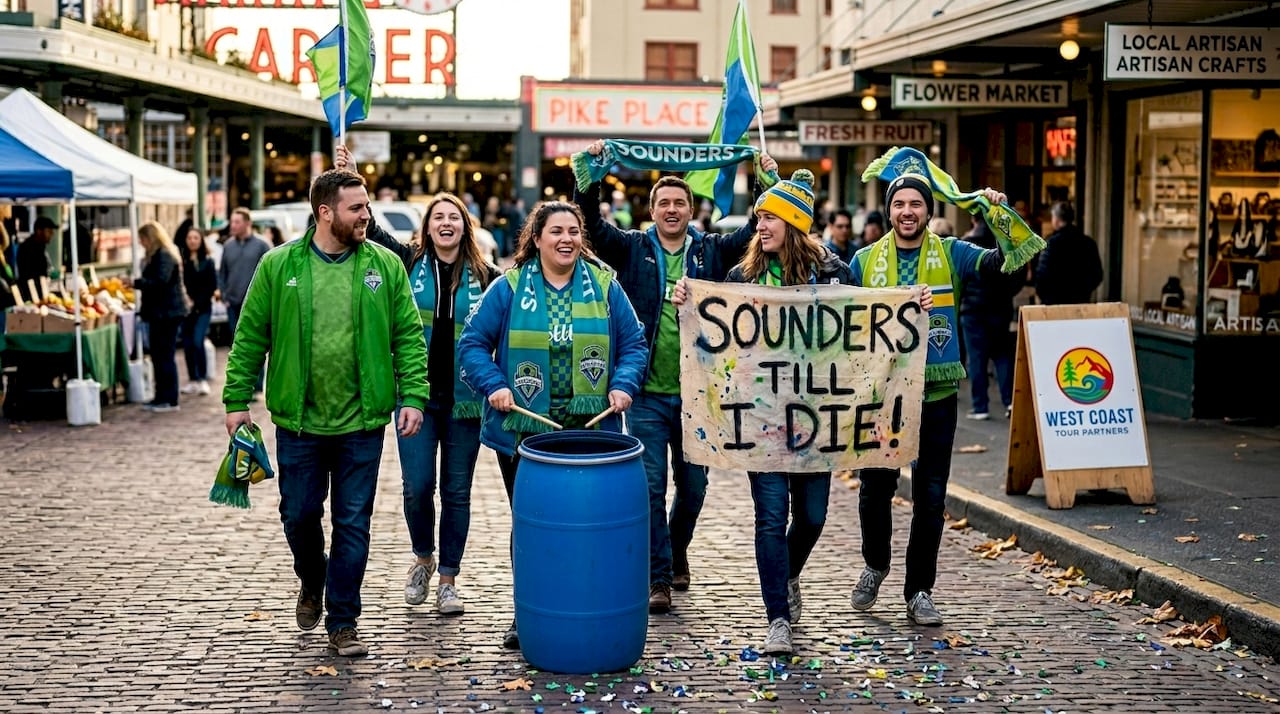
The Emerald City Supporters and other supporter groups have built a culture of choreography, chant writing, and community that rivals anything you would find in European soccer. This is not mimicry. It grew organically from the decades of fan devotion described above.
Pro Tip: If you are visiting Seattle for a Sounders match, join the March to the Match even if you do not have a ticket. The experience of moving through the city streets with thousands of supporters is its own event entirely.
The club also maintains a deep connection to local talent. Seattle Sounders FC consistently features the most locally developed roster among all Seattle professional sports franchises. Players born in Washington state and developed through regional academies represent the club at the highest level, which keeps the fan-player bond personal and the community investment real.
Youth soccer, women’s soccer, and statewide growth
The professional story sits on top of a grassroots structure that most fans underestimate. The Seattle Youth Soccer Association has been the engine of regional player development for decades, and its geographic boundary approach created strong neighborhood club identities that feed talent into the professional pipeline.
Title IX and local pioneers transformed women’s soccer in Seattle beginning in the 1970s. Women’s leagues that started with a handful of teams had expanded to over 100 teams within a decade. That growth eventually produced Seattle Reign FC, founded in 2012, which became a flagship club in the National Women’s Soccer League and attracted world-class players including Megan Rapinoe.
The broader soccer ecosystem in Washington state includes several key threads worth knowing:
- Seattle Reign FC has consistently competed at the top of women’s professional soccer, connecting local girls’ club soccer to elite pathways
- Sounders FC community outreach includes matches in Spokane and youth programs designed to make soccer accessible beyond the Seattle metro area
- Neighborhood youth leagues in South Seattle and the Eastside serve large immigrant communities from Central America and East Africa, continuing the same immigrant-to-professional pipeline started by Welsh miners in the 1880s
- High school soccer in Washington state draws more participants than basketball in many districts, reflecting how deeply the sport has embedded itself in the state’s sports culture
The statewide soccer culture is not an afterthought. It is the base layer. Without the youth associations, the women’s leagues, and the community clubs, the professional clubs lose their context and their connection to the people who matter most.
The 2026 FIFA World Cup and Seattle’s global moment
Seattle has earned a prominent role in the 2026 FIFA World Cup, and for fans who understand the history, this moment feels completely logical rather than surprising. The city is hosting six World Cup matches, reflecting its infrastructure, its fan capacity, and its decades of demonstrated soccer passion.
The centerpiece of the city’s celebration is the Seattle Soccer Celebration, an event series conceived as more than a tournament watch party. Events at Pier 62 are designed as global gathering places connecting maritime history, innovation, and fan passion, aiming to create a lasting cultural legacy that extends well past the final whistle of the last match.
Key elements of Seattle’s 2026 World Cup soccer story include:
- Six matches hosted at Lumen Field, leveraging the stadium’s proven capacity for major soccer crowds
- The Seattle Soccer Celebration at Pier 62 offering a global cultural gathering space that celebrates soccer’s connection to community and history
- Statewide programming designed to use the World Cup moment as a catalyst for soccer growth in communities outside Seattle
- Direct visual and narrative connections to the waterfront and maritime culture that shaped the city’s earliest soccer communities
The 2026 World Cup does not launch Seattle’s soccer identity. It announces it to the world.
My take on what this history means for fans today
I’ve spent years exploring what makes Seattle’s sports culture genuinely different, and when it comes to soccer, I keep arriving at the same conclusion. The thing that separates this city from most American soccer markets is not the trophies, even nine of them. It’s the unbroken thread.
From Welsh miners kicking a ball in 1890 to the March to the Match filling the streets in 2026, the culture has never had to be invented from scratch. It got interrupted. It adapted. It came back stronger. That continuity is rare in American sports, and soccer fans here carry it with real pride.
What I find most worth noting is the player-fan relationship. Most American pro sports maintain a careful distance between athletes and supporters. Seattle soccer punched through that distance in the NASL era and never put the wall back up. Players who came through this system talk about it differently. They describe feeling genuinely part of the city, not just employed by one of its teams.
My honest view is that this history should change how you watch a Sounders or Reign match. When you see that stadium full, or you hear the March to the Match drums moving through the street, you are not watching a recent phenomenon built on marketing budgets. You are watching something that was earned over 130 years. That context makes every goal feel heavier and every championship feel like a collective exhale for an entire city.
What other cities can take from Seattle is simple. Build the base first. Invest in youth soccer, support women’s soccer, make the community feel the sport belongs to them. Seattle did not manufacture passion. It cultivated it, over generations, starting with immigrants who just wanted to play.
— WCTP_Systems
Experience Seattle’s soccer legacy in person
Reading about Seattle’s soccer culture is one thing. Standing in the neighborhoods where it was made is something else entirely. West Coast Tour Partners designs exactly these kinds of experiences, connecting visitors and soccer fans to the living history of the city through story-driven tours that go well beyond the typical highlights.

Whether you’re arriving on a cruise, planning a trip around a Sounders or Reign match, or simply want to understand Seattle from the inside out, West Coast Tour Partners offers curated Seattle experiences that bring the history and culture to life. From waterfront storytelling tours to immersive Pike Place Market adventures, every experience is built to make you feel the city rather than just observe it. If you want to walk the same neighborhoods where Seattle’s soccer story began, there is no better way to start than with a guided experience tailored to curious, passionate visitors like you.
FAQ
When did soccer first come to Seattle?
Soccer arrived in Seattle via Welsh and Italian immigrant coal miners in the 1880s, with the first documented game in Washington state recorded in 1890 near Chehalis.
When did the original Seattle Sounders play?
The original Seattle Sounders competed in the North American Soccer League starting in 1974. They became the first NASL team to sell out their venue and expanded stadium capacity in their debut season.
How many trophies has Seattle Sounders FC won?
Seattle Sounders FC has won nine major trophies, making the club the first in U.S. history to claim every major competition, including the MLS Cup, U.S. Open Cup, and Concacaf Champions Cup.
What is the March to the Match?
The March to the Match is a Seattle fan tradition where supporters gather before home games and march together to Lumen Field, creating one of the loudest and most energized atmospheres in MLS.
Is Seattle hosting games at the 2026 FIFA World Cup?
Yes. Seattle is hosting six matches at the 2026 FIFA World Cup, with surrounding cultural events like the Seattle Soccer Celebration at Pier 62 designed to celebrate the city’s deep soccer legacy on a global stage.
Leave a Reply