
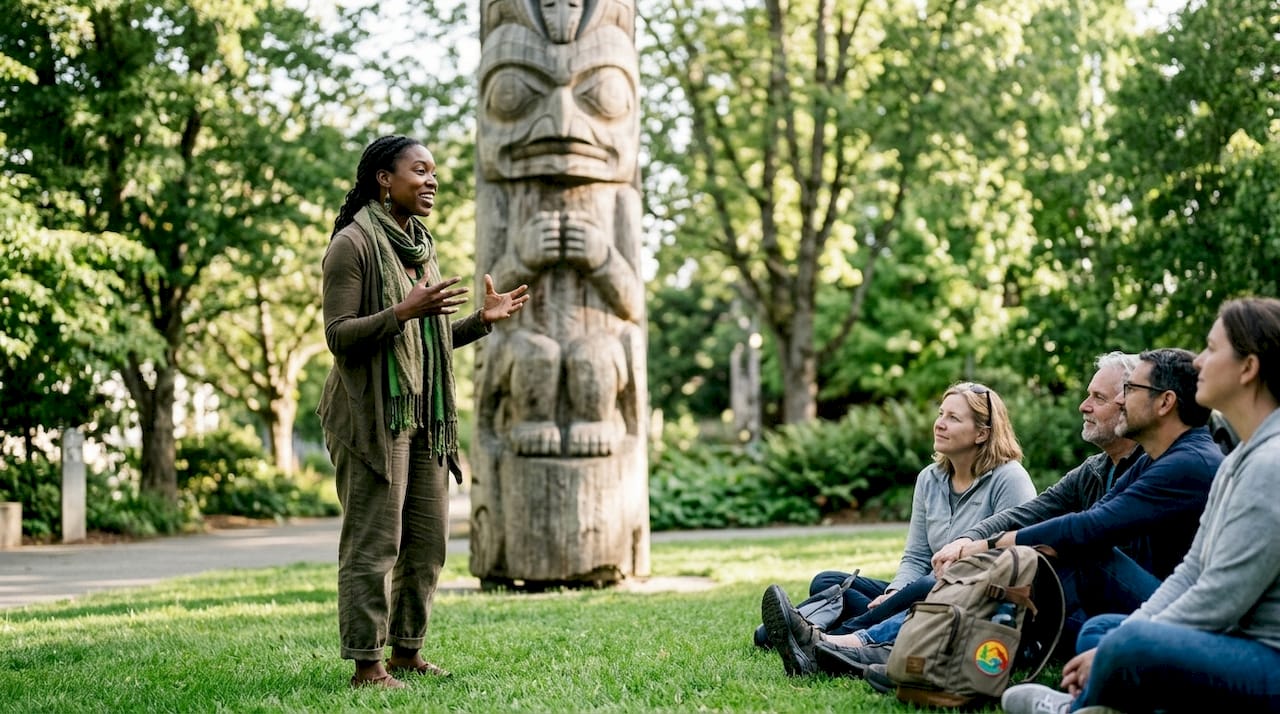
Seattle’s cultural landmarks are defined not by their architecture alone, but by the layered community histories, political struggles, and shared identities embedded within them. Places like The People’s Wall, Tolliver Temple, and Pioneer Square carry the seattle cultural landmarks deeper meaning that separates a genuine cultural site from a mere historic building. These landmarks function as living documents, recording the voices of Black, Indigenous, Jewish, and Asian American communities whose stories rarely made it into official histories. Understanding what these sites truly represent transforms a visit to Seattle from sightseeing into something far more meaningful.
What qualifies as deeper meaning in Seattle’s cultural landmarks?
Deeper meaning, in the context of landmark preservation, refers to the social, political, and community significance a site holds beyond its physical form. Architects and historians use the term “cultural significance” to describe this layered value, and Seattle’s landmark designation process takes it seriously. Seattle has over 400 designated landmarks that must be at least 25 years old and demonstrate significance in history, culture, or economics. That number reflects a city actively working to preserve more than just beautiful old buildings.
The criteria for designation reveal exactly where deeper meaning lives:
- Association with historic events: A site gains significance when it witnessed or shaped a turning point in community life, such as a civil rights protest or a labor strike.
- Connection to important figures: Buildings linked to leaders like Angela Davis or Langston Hughes carry the weight of those legacies.
- Cultural and political heritage: Landmarks tied to ethnic communities, religious traditions, or political movements reflect histories that shaped Seattle’s identity.
- Architectural integrity combined with social context: The physical structure matters, but only when paired with the human story it shelters.
What makes Seattle’s approach notable is that community-led landmark petitions increasingly include stories outside elite, high-society narratives. Advocates are using the designation process to surface ethnic and social histories that formal registries previously excluded. This shift means that the deeper meanings of Seattle landmarks are actively expanding, not fixed in the past.
Which Seattle landmarks illustrate complex, layered cultural histories?
Three sites stand out as the clearest examples of how cultural heritage in Seattle landmarks operates on multiple levels simultaneously.
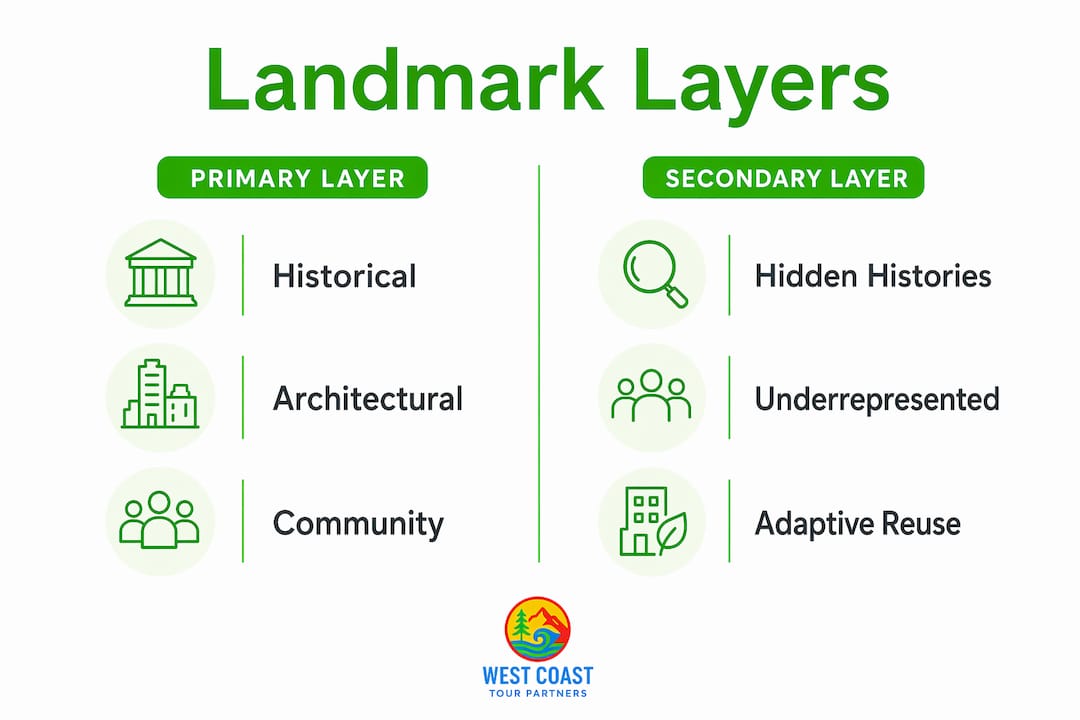
| Landmark | Primary Layer | Hidden or Secondary Layer |
|---|---|---|
| The People’s Wall | Black Panther Party activism, 1970 | Last physical fragment of demolished headquarters |
| Tolliver Temple | Black congregation worship space | Originally built as a Jewish synagogue |
| Pioneer Square | Post-Great Fire economic rebuilding | Prohibition-era speakeasy culture underground |
The People’s Wall is a 38.5-foot mural painted in 1970 at the site of the Seattle chapter of the Black Panther Party’s second headquarters. In May 2026, the Seattle Landmarks Preservation Board voted unanimously to designate it an official landmark, recognizing its historic, cultural, and artistic value. That unanimous vote signals how clearly the board recognized the mural’s role as a symbol of Black political activism and community memory, not simply as public art.
Tolliver Temple tells a different kind of layered story. The building originally served as a synagogue before being purchased and used by a Black congregation, all while preserving shared Jewish symbols within its walls. This shared Black and Jewish history within a single structure illustrates how a building’s meaning compounds over time, accumulating the identities of every community that called it home.
Pioneer Square adds yet another dimension. Built after the Great Fire of 1889, the neighborhood’s architecture reflects Seattle’s economic ambition during the mining boom era. Less known is its underground history: the Pioneer Building and surrounding structures served as speakeasies during Prohibition, revealing a covert social culture that operated beneath the respectable surface. Pioneer Square is a deliberate cultural memory site that blends architecture with social history in ways most visitors never notice.
Pro Tip: When visiting Pioneer Square, book a Seattle Underground Tour to access the subterranean passages beneath the streets. The physical space below ground makes the Prohibition-era history tangible in a way no surface-level walk can replicate.
How do underrepresented communities shape the deeper meaning of Seattle landmarks?
The cultural heritage of Seattle landmarks is inseparable from the communities that built, occupied, and fought to preserve them. Yet only a small percentage of Seattle’s official landmarks are associated with Black heritage, making sites like The People’s Wall and the Soul Pole critically important anchors for community identity. Community advocates emphasize that preservation provides a vital sense of placement and meaning for histories long denied recognition by formal registries. That gap between what exists and what gets officially recognized is itself a form of cultural erasure.
“Preservation of Black heritage landmarks helps provide a sense of placement and meaning for underrepresented histories long excluded from formal recognition.” — Community advocates, South Seattle Emerald
Several communities have shaped the iconic places in Seattle that define its cultural identity:
- Black Seattle: The Soul Pole, a 21-foot totem pole installed in 1973 at the Douglass-Truth Branch Library, represents 400 years of African American history and stands as a beacon of Black pride in the Central District. The People’s Wall reinforces that same tradition of public, visible cultural assertion.
- Asian American and Native communities: Seattle’s AANHPI community history is reflected in historic neighborhoods and institutions like the Seattle Asian Art Museum, which honors contributions that shaped the city’s cultural fabric from its earliest decades.
- Jewish Seattle: Tolliver Temple’s original life as a synagogue represents a Jewish community that built lasting physical infrastructure in the Central District, infrastructure that later served the Black community that followed.
Understanding Seattle’s cultural history requires recognizing that these communities did not exist in isolation. Their stories overlapped, intersected, and sometimes shared the same physical walls. The landmark designation process, when it works well, captures that complexity rather than flattening it into a single narrative.
How does adaptive reuse deepen the meaning of Seattle’s landmarks?
Adaptive reuse is the practice of repurposing a building for a new use while retaining its historic fabric, and it is one of the most powerful forces shaping the deeper meanings of Seattle landmarks. When a building serves successive communities across generations, it accumulates layers of meaning that no single-use structure can match.
Here is how that process works in Seattle’s most significant examples:
- Original construction with community intent: Tolliver Temple was built as a synagogue, designed to serve a specific religious and ethnic community in the Central District. The architecture itself encoded that community’s values and identity.
- Transfer of ownership and use: As Seattle’s Central District demographics shifted, the building passed to a Black congregation. Rather than erasing the previous occupants, the new community preserved Jewish symbols within the structure, creating a physical record of both histories.
- Landmark designation as cultural acknowledgment: The push to designate Tolliver Temple as a landmark formally recognizes that nearly 100 years of layered narratives within a single building constitute a unique form of cultural heritage worth protecting.
- Fragment preservation when full structures are lost: When the Black Panther Party’s headquarters was demolished in 1973, The People’s Wall mural remained as the sole physical reminder of that site. A fragment, in this context, carries the full weight of what was lost.
Fragments like The People’s Wall serve as anchors for collective memory precisely because the original structure is gone. The mural’s survival is not incidental. It is the reason the community’s connection to that place persists at all. This principle challenges the common assumption that landmark preservation requires intact buildings. Sometimes a wall is enough.
Pro Tip: Before visiting any Seattle landmark tied to underrepresented communities, read one firsthand account from a community member connected to that site. The South Seattle Emerald and The Seattle Times both publish community-sourced histories that reframe what you see when you arrive.
Key takeaways
Seattle’s cultural landmarks carry their deepest meaning through the layered histories of the communities that built, occupied, and fought to preserve them, not through architecture alone.
| Point | Details |
|---|---|
| Landmark criteria reveal deeper meaning | Seattle’s 400+ designated landmarks must show cultural, historic, or economic significance beyond physical form. |
| Adaptive reuse compounds cultural value | Buildings like Tolliver Temple gain meaning by serving successive communities across nearly a century. |
| Fragments preserve what demolition erases | The People’s Wall mural survives as the sole physical anchor for the Black Panther Party’s presence in Seattle. |
| Underrepresented histories are underprotected | Few of Seattle’s official landmarks recognize Black heritage, making community advocacy critical to preservation. |
| Visitor knowledge transforms the experience | Understanding the social and political context of a landmark converts sightseeing into genuine cultural connection. |
Why surface-level sightseeing misses the point entirely
I have spent years watching visitors photograph Pioneer Square’s red brick facades without knowing they are standing above a network of underground passages that once sheltered illegal saloons. They admire The People’s Wall as striking public art without knowing the building behind it was demolished over 50 years ago, and that the mural is all that remains of a political headquarters that shaped Seattle’s civil rights history. That gap between what people see and what is actually there is the central problem with how most people experience Seattle.
What I find most compelling about Seattle’s approach to landmark preservation is that it is not static. The unanimous 2026 vote to designate The People’s Wall happened because community advocates pushed for it, not because the city’s historic preservation system automatically recognized its value. That tells you something important: the deeper meanings of these places are not self-evident. They require someone to explain them, and they require visitors who are genuinely curious enough to listen.
The landmarks tied to Black, Jewish, Indigenous, and Asian American communities are not footnotes to Seattle’s main story. They are the main story. Tolliver Temple’s shared history is more interesting than any single-community narrative could be. The Soul Pole at the Douglass-Truth Branch Library encodes 400 years of African American history in a 21-foot carved form. These are not supplementary attractions. They are the places where Seattle’s actual character lives. Visiting Seattle without understanding them is like reading a book with half the pages removed.
— WCTP_Systems
Discover Seattle’s hidden histories with West Coast Tour Partners
The stories behind Seattle’s most significant cultural sites deserve more than a quick glance from the sidewalk. West Coast Tour Partners designs immersive Seattle experiences that go well beyond surface-level sightseeing, connecting you directly to the community histories, political legacies, and cultural layers that make this city genuinely extraordinary.

From the Central District’s civil rights landmarks to the underground passages of Pioneer Square, West Coast Tour Partners guides bring these stories to life through expert storytelling, local knowledge, and experiences built for curious travelers. Whether you are arriving by cruise ship or planning a dedicated cultural exploration of the city, the team at West Coast Tour Partners makes sure you leave knowing Seattle’s real story, not just its postcard version.
FAQ
What does “deeper meaning” mean for a Seattle landmark?
Deeper meaning refers to the social, political, and community significance a landmark holds beyond its physical structure. Seattle’s designation criteria require sites to demonstrate historic, cultural, or economic importance, which surfaces layers of meaning tied to specific communities and events.
Why is The People’s Wall considered historically significant?
The People’s Wall is a 38.5-foot mural painted in 1970 at the site of the Seattle Black Panther Party’s second headquarters. It was unanimously designated a Seattle landmark in May 2026 and stands as the sole surviving physical connection to a demolished building central to Seattle’s civil rights history.
What is adaptive reuse and why does it matter for Seattle landmarks?
Adaptive reuse describes a building repurposed for new uses while retaining its historic fabric. Tolliver Temple, originally a synagogue and later a Black church, is Seattle’s clearest example of how successive community occupation creates richer cultural meaning than any single-use history could.
Which underrepresented communities have shaped Seattle’s landmark history?
Black, Jewish, Asian American, and Indigenous communities have all shaped the cultural heritage of Seattle landmarks. Sites like the Soul Pole, Tolliver Temple, and the Seattle Asian Art Museum reflect contributions that formal historic registries have historically underrepresented.
How can visitors access the deeper histories of Seattle’s landmarks?
Reading community-sourced journalism from outlets like the South Seattle Emerald before visiting adds essential context. Guided tours that specialize in cultural and historical storytelling, like those offered by West Coast Tour Partners, provide the most direct access to these layered narratives.
Recommended
- Top 4 savorseattle.com Alternatives Providers 2026 – West Coast Tour Partners
- Top 3 eatseattletours.com Alternatives Providers 2026 – West Coast Tour Partners
- Seattle Market District Tour Explained for Visitors – West Coast Tour Partners
- What Is Pike Place Market? Seattle’s Historic Public Market – West Coast Tour Partners
Leave a Reply