
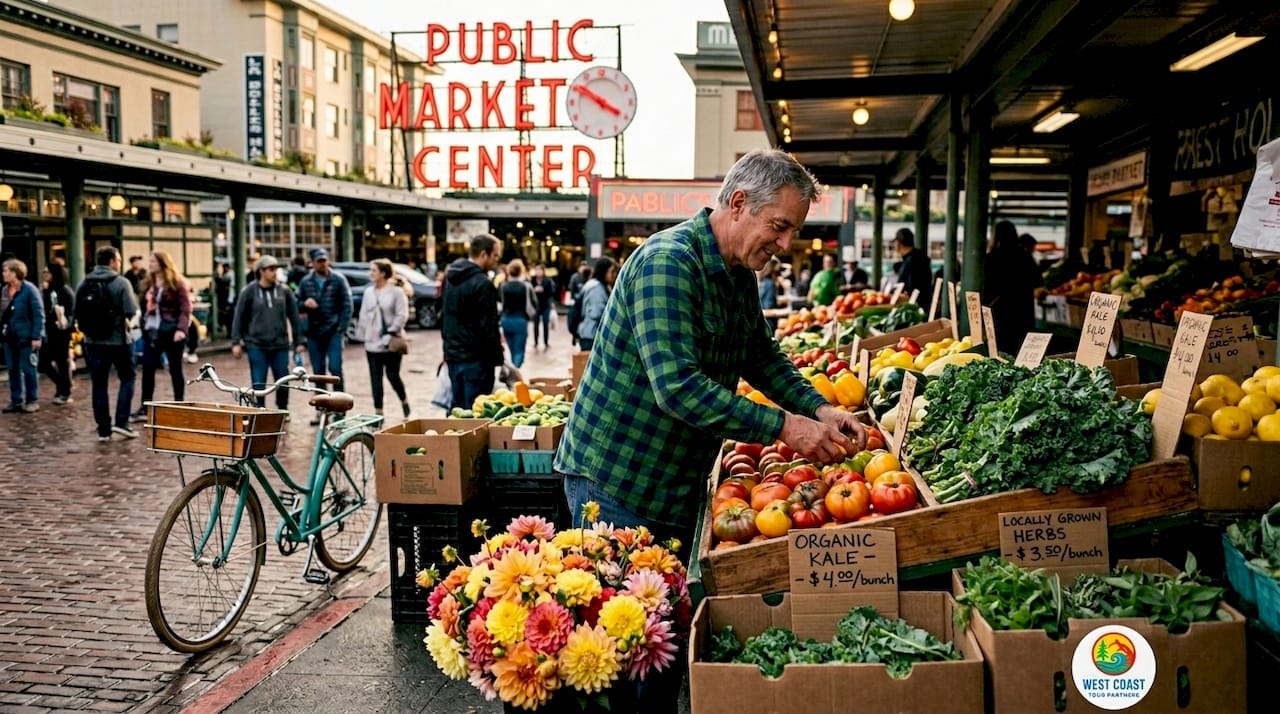
Few places in America carry the weight of history as naturally as Pike Place Market. With seattle public market history explained through more than a century of farmers, activists, fishmongers, and everyday residents, this nine-acre district on the Seattle waterfront tells a story far richer than most visitors realize. It began not as a tourist attraction but as an act of economic defiance, and understanding that origin changes everything about how you experience it today.
Table of Contents
- Key takeaways
- Seattle public market history explained: the 1907 founding
- Growth, buildings, and the WWII disruption
- The preservation fight that saved the Market
- The Market’s modern role as a living district
- Traditions, icons, and legacy businesses
- My take on what the Market’s history really teaches us
- Explore the Market with West Coast Tour Partners
- FAQ
Key takeaways
| Point | Details |
|---|---|
| Founded on fairness | Pike Place Market opened in 1907 so farmers could sell directly to consumers and bypass price-gouging middlemen. |
| Shaped by WWII | Japanese-American farmer displacement in 1942 permanently altered the Market’s vendor community and later fueled preservation activism. |
| Saved by voters | A 1971 citizen initiative created a historic preservation zone that stopped demolition and led to formal stewardship under the PDA. |
| More than a market | Today the district includes 222 shops, 69 farmers, 150 craftspeople, and over 450 residents living within the historic buildings. |
| Tourism meets community | The Market Foundation has granted over $30 million toward housing, healthcare, and food access for its most vulnerable neighbors. |
Seattle public market history explained: the 1907 founding
The story of how Seattle’s public market came to be is one of the more satisfying founding stories in American urban history, because it started with ordinary people getting fed up. In the early 1900s, Seattle produce prices were driven sky-high by a network of middlemen who bought from farmers at low prices and resold to consumers at enormous markups. City officials finally stepped in.
A city ordinance allowed farmers to sell directly to consumers at a designated public space on Pike Place, cutting out the profit chain entirely. On opening day, August 17, 1907, vendors sold out by noon. The response was so overwhelming that the number of farmers wanting to participate grew rapidly within weeks.
Those early days established a few key realities about the Market:
- Farmers owned the relationship with their customers directly, with no brokers or agents involved.
- The city’s role was structural, providing space and ordinance protection rather than managing operations.
- Success bred growth fast, pushing the need for permanent, covered market buildings.
Early key figures included City Council member Thomas Revelle, who championed the original ordinance, and Frank Goodwin, whose family owned much of the surrounding real estate and financed the first permanent arcade building. Their combined effort turned a single market day into a permanent civic institution within just a few years.
Pro Tip: If you want to feel the founding energy of the Market, arrive early on a weekday morning when the farmers’ tables are freshly stocked. The pace and directness of the vendor-to-customer interaction has genuinely not changed since 1907.
Growth, buildings, and the WWII disruption
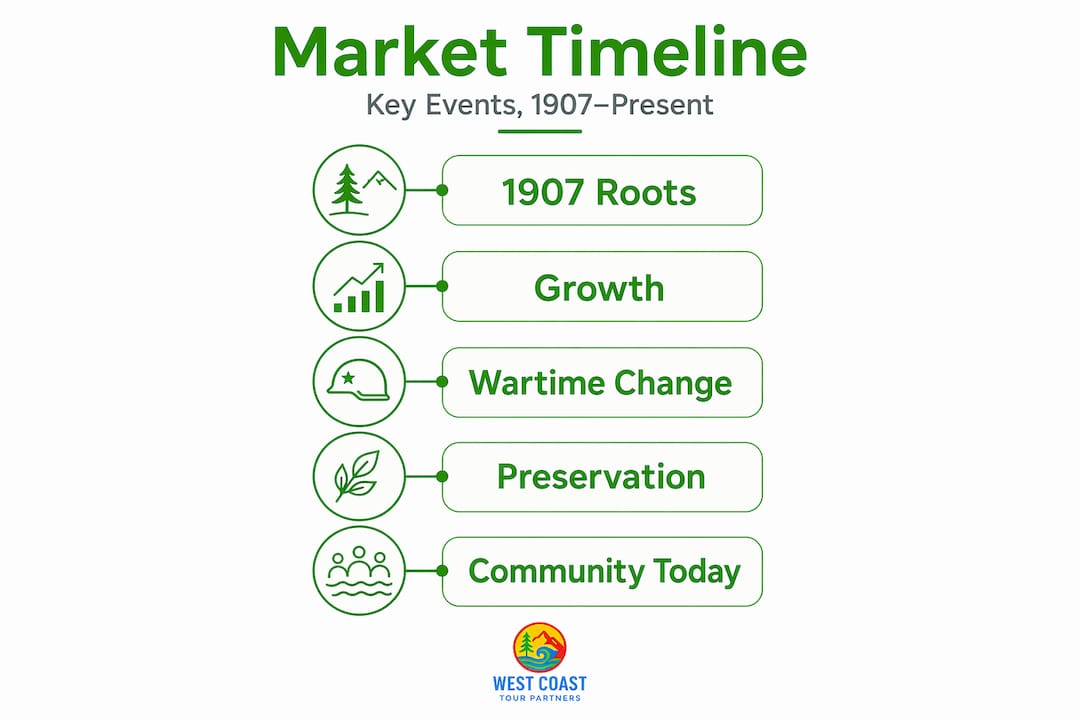
Through the first decades of the 20th century, the Seattle public market timeline expanded steadily. New buildings went up along the Pike Place hillclimb, including the Main Arcade, the Corner Market Building, and the Triangle Building. Bakeries, fish vendors, specialty grocers, and small restaurants filled the lower levels. A branch of the Seattle Public Library even operated within the district for a period, reflecting how central the Market was to daily neighborhood life.
The demographic makeup of the vendor community during this era is one of the most significant and underappreciated parts of Pike Place Market facts. Japanese-American farming families formed the backbone of the fresh produce stalls by the 1930s, having built deep customer relationships over years of quality and consistency.
Then World War II arrived. Executive Order 9066 in 1942 forced the internment of Japanese Americans across the West Coast, and Seattle’s market lost many of its most experienced and loyal vendors almost overnight. Properties were confiscated or sold at distress prices. Decades of community trust were severed in a matter of weeks.
The table below shows how the Market’s vendor community shifted across key historical periods:
| Period | Key vendor groups | Notable change |
|---|---|---|
| 1907 to 1920s | Local farmers, European immigrants | Rapid growth in stall numbers |
| 1930s | Japanese-American farming families | Dominant fresh produce suppliers |
| 1942 to 1945 | Reduced vendor diversity | Japanese-American displacement |
| Post-war era | Mixed urban vendors | Shift toward urban retail, decline in farm stalls |
The post-war period saw the Market drift away from its agricultural roots. Chain stores and suburban grocery culture drew customers away. By the 1960s, the district was in physical decline, and city planners saw the land as prime real estate for redevelopment.
Pro Tip: The Wing Luke Museum in Seattle’s Chinatown-International District tells the story of Japanese-American internment with exceptional depth. Pairing that visit with a Market trip gives you a fuller picture of what the displacement actually meant for this community.
The preservation fight that saved the Market
The history of Seattle markets took its most dramatic turn in the late 1960s, when the city floated a redevelopment plan that would have demolished Pike Place Market entirely in favor of a hotel, apartments, and a parking garage. The proposal treated the Market as blight. Seattle residents treated it as a betrayal.
A grassroots campaign led by architect Victor Steinbrueck and a coalition of citizens, artists, and local activists pushed back hard. Their effort had a clear four-part strategy:
- Rally public opinion by framing the Market as a living community, not just a shopping destination.
- Collect enough signatures to place a preservation initiative on the ballot.
- Pass the initiative to legally designate the Market as a historic zone.
- Create a governing authority capable of managing the district long-term without political interference.
On November 2, 1971, Seattle voters passed Initiative 1, establishing the Pike Place Market Historical District and prohibiting demolition or incompatible redevelopment. It was a genuinely rare moment in American urban history where citizens used the ballot box to protect a place.
The Market was saved not because it was profitable, but because people understood it belonged to the whole city. That principle, community ownership of public space, is what the 1971 vote actually codified.
Two years later, the Pike Place Market Preservation and Development Authority was chartered as a public, nonprofit body to manage the historic properties. The governance shift from informal vendor-led organization to formal institutional stewardship was critical. It gave the Market a legal structure capable of resisting future redevelopment pressure while still adapting to changing economic realities.
The Market’s modern role as a living district
Understanding the Pike Place origin story fully means recognizing what the Market has become today, which is far more layered than most visitors expect. The Market is a nine-acre historic district with 24 buildings, 222 shops, 69 farmers, approximately 150 craftspeople, and more than 450 residents living within those historic walls. It functions simultaneously as a farmers market, a retail destination, a residential neighborhood, and a social services hub.
That last point gets overlooked constantly. The Pike Place Market Foundation, established in 1982, has granted over $30 million to support affordable housing, healthcare clinics, food access programs, and childcare for the low-income residents and workers who call the district home. The Market is one of the few tourist destinations in America that actively uses its commercial success to subsidize its most vulnerable community members.
Tourism is enormous. The Market attracts more than 20 million visitors annually, making it Seattle’s top destination by a wide margin. That volume creates real tension. Day-trippers hunting for flying fish and Starbucks photos share the aisles with locals doing their weekly grocery shopping and residents heading to their apartments upstairs. The Market management has consistently tried to protect the working-market character from being swallowed entirely by the tourist economy, with mixed but genuine success.
What makes the Pike Place Market significance so durable is exactly this tension. It has never been allowed to become a theme park, and it has never been allowed to collapse into irrelevance. The PDA governance model holds both pressures in check.
Traditions, icons, and legacy businesses
No overview of the history of Seattle markets is complete without the specific traditions and landmarks that give Pike Place its unmistakable identity.
- The flying fish. The fishmongers at Pike Place Fish Market began throwing salmon to each other in the 1980s as a crowd entertainment strategy. What started as a practical way to move fish across a busy counter became a celebrated performance and a worldwide symbol of workplace culture.
- The neon sign. The iconic Public Market Center sign was erected in 1927 and is one of the oldest operating outdoor neon signs on the West Coast. It has become the single most photographed element of the Market’s exterior.
- Rachel the pig. The bronze piggy bank near the main entrance collects donations that go directly to Market social service programs. Rachel has raised hundreds of thousands of dollars since her installation and is genuinely beloved by regular visitors.
- Starbucks’ original location. The first Starbucks store opened near the Market in 1971 and continues to operate with the original brown mermaid logo not used anywhere else in the chain. The line is long, but the historical context makes it worth understanding.
- Three Girls Bakery. Operating since 1912, Three Girls is one of the oldest continuously operating businesses in the Market and one of the clearest living threads back to the original vendor community.
Pro Tip: Skip the main entrance photo line and walk around to the lower Pike Place arcade levels. The Market’s best-hidden vendors, produce stalls, and craftspeople operate there with almost no tourist foot traffic.
My take on what the Market’s history really teaches us
I’ve spent a lot of time thinking about what makes Pike Place Market genuinely different from other historic public markets around the world, and my honest answer is governance. Most historic markets either get preserved as museums or slowly become upscale food halls for wealthy tourists. Seattle’s Market avoided both fates because the 1973 PDA charter gave a public, nonprofit body both the legal authority and the financial incentive to keep the market working and mixed-income.
What visitors often miss is that the Market is not trying to recreate 1907. It is trying to hold onto the social principle behind 1907: that public market space belongs to the whole community, not just to those who can pay the highest rents. That is a much harder thing to maintain than a historic facade.
The WWII internment chapter is where I think most historical accounts go wrong by treating it as a footnote. In my view, the displacement of Japanese-American farmers is the single most important event in the Market’s social history because it demonstrated exactly what happens when a market community loses its anchoring vendors. The subsequent decline of the Market through the 1950s and 60s is a direct consequence. The preservation activists of 1971 were, consciously or not, trying to prevent that kind of irreversible loss from happening again.
Any city looking to preserve a public market would do well to study Seattle not for its neon sign or flying fish, but for the unglamorous work of institutional design that kept the whole thing alive.
— WCTP_Systems
Explore the Market with West Coast Tour Partners
There is a real difference between walking through Pike Place Market and actually understanding what you are looking at. West Coast Tour Partners offers immersive, story-driven experiences designed specifically to bring the history, hidden corners, and living culture of the Market to life for visitors.

The Market Experience by West Coast Tour Partners takes you through the sights, sounds, and flavors of Pike Place with expert guided storytelling, local food tastings, and interactive challenges that reveal layers most visitors never discover on their own. Whether you are arriving from a cruise terminal or spending a few days exploring Seattle, these experiences are built to feel like an adventure rather than a lecture. Plan your Seattle Market visit with West Coast Tour Partners and see why history enthusiasts and first-time travelers consistently call it the most memorable part of their trip.
FAQ
When did Pike Place Market first open?
Pike Place Market opened on August 17, 1907, with farmers selling directly to consumers under a city ordinance designed to eliminate price-gouging middlemen. Vendors sold out by noon on the first day.
Why was Pike Place Market almost demolished?
In the 1960s, Seattle city planners proposed replacing the Market with a hotel, apartments, and parking facilities, viewing the aging district as blighted real estate. A citizen-led campaign defeated the plan through a 1971 ballot initiative.
What is the Pike Place Market Preservation and Development Authority?
The PDA is a public, nonprofit body chartered in 1973 to manage Pike Place Market’s historic buildings and balance commercial viability with community and residential uses. It remains the governing authority today.
How many people visit Pike Place Market each year?
The Market attracts more than 20 million visitors annually, making it the most visited destination in Seattle and one of the busiest public markets in the United States.
What social services does Pike Place Market provide?
The Pike Place Market Foundation, established in 1982, has granted over $30 million to support affordable housing, medical clinics, food access, and childcare for low-income residents and workers within the Market district.
Leave a Reply