

City attraction passes look deceptively simple from the outside. One purchase, dozens of sites, no hassle. But understanding how city attraction passes work reveals a much more layered system than most travelers expect. The reality is that many passes require advance reservations, have strict activation rules, and only save you money if you plan deliberately. This guide breaks down exactly how these passes function, what you actually get, and how to use them in ways that make your trip genuinely smoother and more rewarding.
Table of Contents
- Key takeaways
- How city attraction passes work
- Activation, validity, and usage rules
- Comparing types of city passes
- How to use city passes effectively
- My honest take on city passes after years of using them
- Explore Seattle with West Coast Tour Partners
- FAQ
Key takeaways
| Point | Details |
|---|---|
| Activation starts on first use | Your validity window begins the moment you scan into your first attraction, not when you purchase. |
| Reservations are often required | Many passes do not guarantee entry without booking a timed slot at each attraction in advance. |
| One entry per attraction | Most passes allow a single admission per included site, so strategic itinerary planning matters. |
| Match the pass to your travel style | Unlimited vs. count-based passes suit different travelers. Choosing wrong wastes money. |
| Compare individual ticket costs first | Pass pricing can be deceptive when processing fees and excluded discounts are factored in. |
How city attraction passes work
At their core, city attraction passes are bundled admission products. You pay a single upfront price and receive access to a curated collection of museums, landmarks, tours, and experiences within a city. Think of it as a prepaid sampler that replaces the individual ticket-buying process at each stop.
The mechanics are straightforward on the surface. Most passes operate digitally now, meaning you receive a QR code after purchase. When you arrive at an included attraction, you scan the code at the entrance and gain admission. QR codes enable faster entry compared to purchasing individual tickets onsite, which is one of the most immediate city pass benefits you will notice on a busy travel day.
Here is what city tourism passes typically bundle together:
- Museum admissions covering art, science, history, and cultural institutions
- Landmark and observation deck access such as city towers, rooftop viewpoints, and historic monuments
- Guided tour inclusions like walking tours, boat tours, and neighborhood explorations
- Transportation credits or passes for public transit or hop-on, hop-off bus routes
- Dining and shopping discounts at partner businesses near major attractions
The specific offerings vary significantly by city and pass provider, so what is included in one city’s pass may look nothing like another’s. That is why reviewing the full attraction list before purchasing is not optional. It is the entire basis for deciding whether a pass makes sense for your trip.
Activation, validity, and usage rules
This is where most travelers get caught off guard. The rules around how attraction passes function in practice are more specific than the marketing materials suggest, and misunderstanding them can cost you both money and time.
Activation timing is critical. Passes typically activate on first use, meaning the validity clock starts the moment you scan into your first attraction, not the day you purchased the pass. If you buy a 7-day pass two weeks before your trip, those seven days only begin when you walk through the first gate. This gives you flexibility in timing your arrival, but it also means you should plan to use the pass heavily once you activate it.
Validity periods differ by product type. Some passes offer consecutive calendar days, such as 3, 5, or 9 days in a row. Others count only the days you actually use the pass. A 3-attraction pass, for example, remains valid until you use all three admissions regardless of how many calendar days pass. Understanding which model your pass uses is the difference between a relaxed itinerary and a frantic one.

One-time entry is the standard rule. Most passes grant a single admission per included attraction. You cannot revisit the same museum twice on the same pass. This matters for planning purposes because it means you need to be deliberate about when and how you visit each site, rather than assuming you can pop back in for a second look.
Reservations are often required and this surprises travelers most. Possessing a pass does not guarantee entry without securing a timed reservation slot. For high-demand sites, early booking is strongly recommended as soon as travel dates are confirmed. The pass covers your admission cost, but the time slot is a separate inventory system that fills up independently. Showing up and expecting walk-in access at a sold-out attraction will leave you frustrated.
Pro Tip: Download any companion app offered with your pass immediately after purchase. Managing reservations through the app lets you track bookings, monitor validity dates, and adjust your itinerary in real time, all from your phone.
Comparing types of city passes
Not all city passes are built the same way. Understanding the differences helps you pick the one that actually fits how you travel, rather than the one with the most attractive headline price.
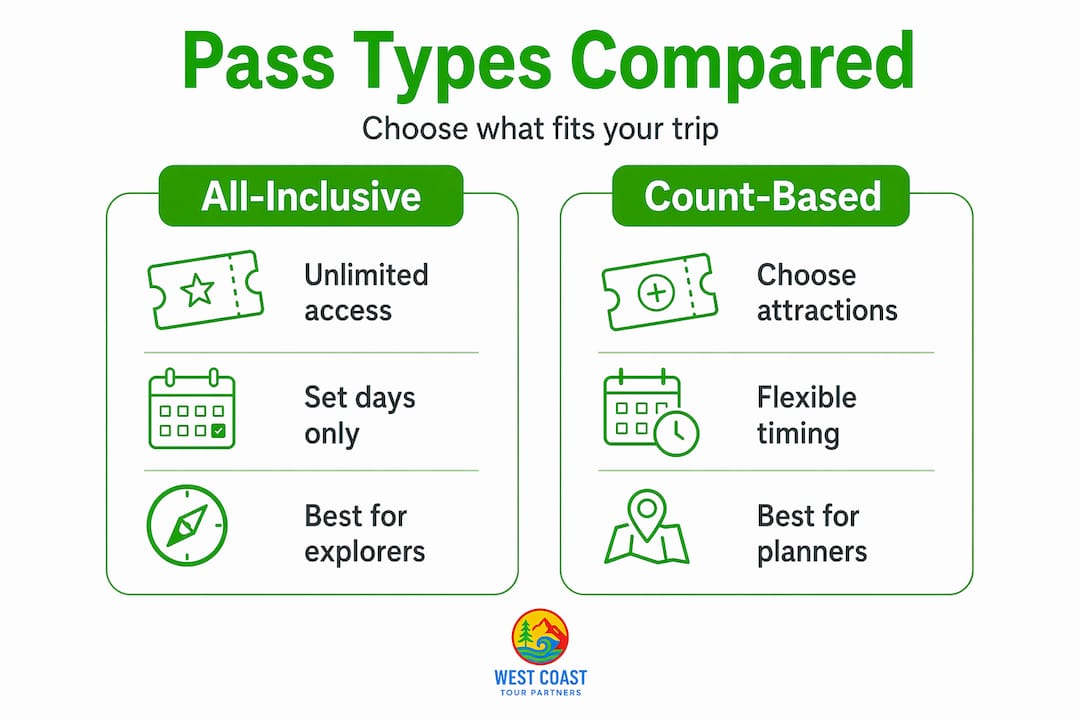
All-inclusive vs. count-based passes
| Pass Type | How it works | Best for |
|---|---|---|
| All-inclusive unlimited | Covers all listed attractions for a set number of days | High-volume travelers visiting 5 or more sites |
| Attraction-count limited | Grants entry to a fixed number of attractions you select | Selective travelers with specific interests |
| Event or festival-specific | Valid only during designated festival dates with capacity limits | Visitors attending a specific event or celebration |
| Fixed attraction list | Entry to a preset group of sites, no swapping | Travelers who want a curated, no-decision experience |
| Flexible choice | Choose your attractions from a larger catalog | Independent travelers who want full control |
Some city passes offer fixed or flexible attraction lists and variable validity periods to accommodate different traveler preferences. Flexible passes tend to appeal to visitors who have already researched what they want to see, while fixed-list passes work well for first-timers who appreciate having the decision made for them.
Here are the key questions to ask before choosing:
- How many attractions will you realistically visit in the time you have?
- Does the pass include the specific sites you care most about?
- Are the included attractions geographically clustered, or will you spend half your time commuting between them?
- Does the pass validity match your trip length, or will days go unused?
On the pricing side, the advantages of city passes are real but not guaranteed. Pass pricing can be deceptive when processing fees are added and when the pass does not cover discounts that seniors, students, or military travelers might qualify for at individual ticket windows. Always run the math using full walk-up prices for only the attractions you plan to visit, not every attraction on the list.
Some passes are also time-bound in ways that go beyond your personal trip. Event-specific passes like Edmonton’s Eat Play Laugh Pass were limited to 2,500 passes and valid only during specific festival dates, meaning scarcity and timing constraints applied regardless of the buyer’s preference. If you are purchasing a pass tied to a festival or seasonal event, treat it with the same urgency you would a concert ticket.
How to use city passes effectively
Buying the pass is the easy part. Using it well is what separates travelers who feel like they got a great deal from those who end the trip wishing they had just bought individual tickets.
-
Book reservations the day you purchase your pass. Do not wait until you arrive. For popular attractions like observation decks or major museums, reservation slots fill quickly and your pass covers cost but not guaranteed entry. Treat your first post-purchase task as opening the app and locking in every time slot you need.
-
Build your itinerary around geography, not excitement. Group nearby attractions together on the same day to reduce transit time. Visiting a waterfront landmark, a harbor tour, and a market-based experience all in one loop is far more efficient than bouncing across the city.
-
Check each attraction’s hours and seasonal variations. Some sites close on Mondays, others have limited hours in off-peak seasons, and a few operate with reduced access during holidays. Confirming hours before you finalize reservations prevents last-minute scrambling.
-
Activate your pass strategically. If you have a 3-day consecutive pass but your trip starts with a light arrival day, do not scan into your first attraction until you are ready to go full speed. The clock only starts when you choose to start it.
-
Know when individual tickets are smarter. If you only want to visit two or three attractions, do the math honestly. A pass that bundles 10 sites rarely delivers its advertised savings if you only use a fraction of what it offers. City attraction discounts at individual ticket windows, especially for groups or families, can sometimes outperform pass pricing.
Pro Tip: For family city attraction passes, look closely at age brackets. Some passes price children under 12 at a significant discount, while others charge near-adult rates. Calculate the total family cost using actual age-based pricing before assuming the family pass is the best value.
My honest take on city passes after years of using them
I have used city tourism passes in more destinations than I can count, and my honest assessment is this: the pass almost never saves you money by accident. It saves you money when you do your homework.
The travelers I have seen struggle with passes are the ones who buy them for the convenience fantasy. They imagine walking up to any door in the city, flashing a QR code, and breezing in. What actually happens is that the best attractions require reservations booked weeks out, and without that planning, your expensive pass becomes a coupon for whatever is still available.
What I have found actually works is treating the pass as a scheduling framework first and a discount product second. The moment you purchase, you sit down with the full attraction list and your calendar and you make decisions. Which five sites genuinely excite you? Which days work for which neighborhoods? That intentional approach is what makes the advantages of city passes real rather than theoretical.
The uncomfortable truth is that picky travelers often get more value than enthusiastic ones. Someone who identifies three attractions they truly want, confirms those three are included, and books reservations immediately will have a better experience than someone who buys a 10-site pass hoping to figure it out on the fly. Patience and specificity beat optimism every time.
— WCTP_Systems
Explore Seattle with West Coast Tour Partners
If you are planning a trip to Seattle and wondering how attraction passes fit into your itinerary, West Coast Tour Partners has built experiences designed to complement exactly that kind of trip. Their lineup includes immersive Pike Place Market tours with guided storytelling and local tastings, the Let’s Go Seattle! Shuttle that turns transportation into its own entertainment experience, and ScooTours for those who want to explore neighborhoods with energy and humor. These are not standard tours you endure. They are experiences you talk about afterward.

Whether you arrive by cruise ship or are spending a long weekend in the city, West Coast Tour Partners offers a connected ecosystem of Seattle adventures that work beautifully alongside any city pass you hold. From waterfront to market to neighborhoods, their experiences are designed to fill the moments between major attraction visits with something genuinely memorable. Browse their full lineup and book your Seattle adventure before the best slots are gone.
FAQ
How do city attraction passes get activated?
Most city attraction passes activate on the first day you use them at an attraction, not on the purchase date. The validity period, whether 3 days or 9, begins from that first scan.
Do city passes actually save money?
City passes save money when you visit enough included attractions to exceed the pass cost. Pass pricing requires careful comparison with individual ticket prices, including fees and any discounts you might qualify for separately.
Can you visit the same attraction twice with a city pass?
Generally no. Most passes allow one admission per included attraction. Repeat entry is rarely permitted and is the exception rather than the rule.
Do you still need reservations if you have a city pass?
Yes, for many attractions. The pass covers your admission cost, but timed entry slots are separate inventory. For high-demand sites, reservations should be made as soon as you know your travel dates.
Are city passes worth it for families?
Family city attraction passes can offer strong value, but the savings depend on the ages of your children and how many sites you plan to visit. Always calculate total family pricing using actual age brackets before purchasing.
Leave a Reply